

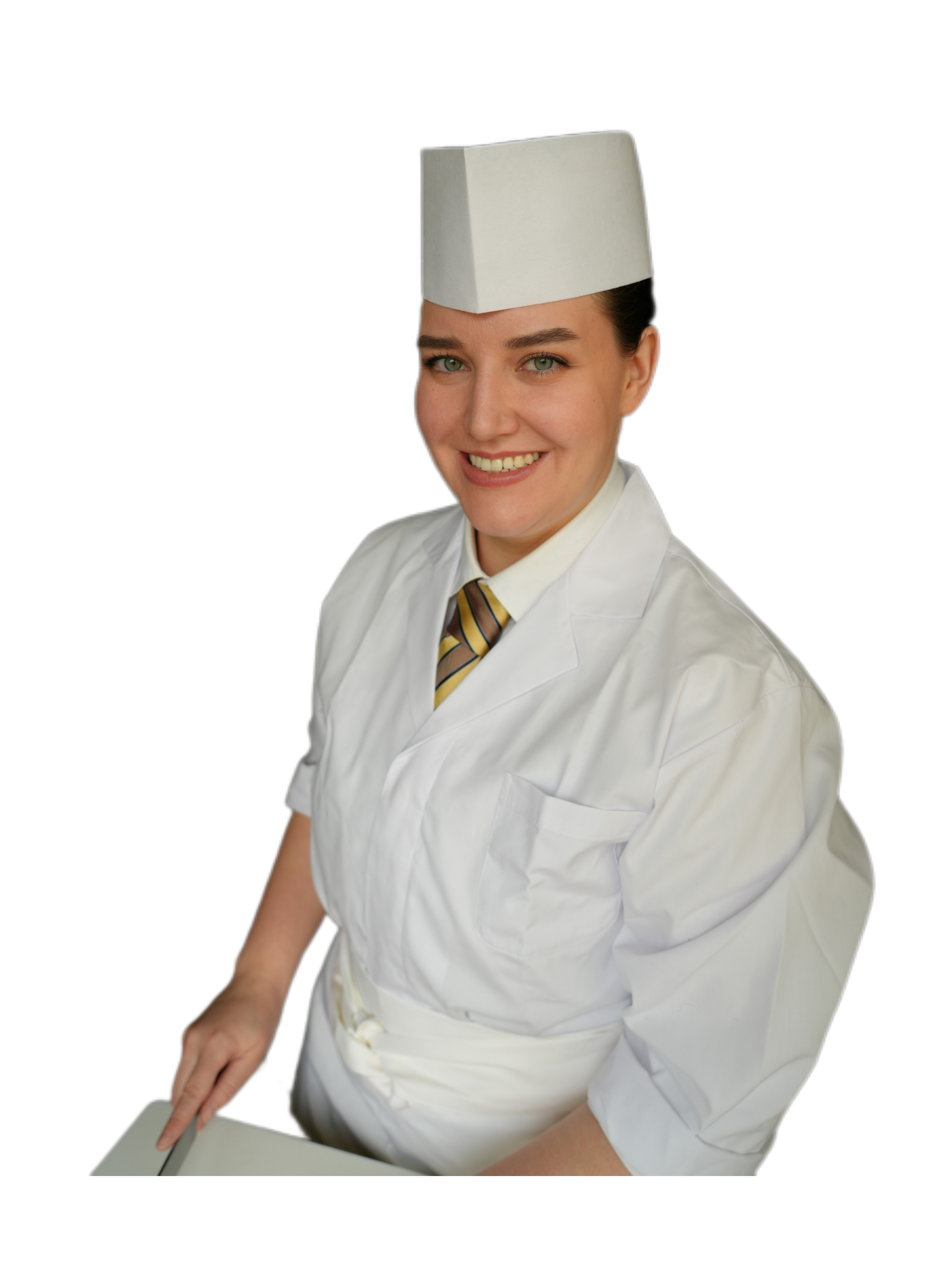
I work within Japanese cuisine as a practitioner and teacher.
My focus is not on blindly reproducing forms,
but on understanding how decisions are made —
in cooking, in presentation, and at the table.
Much of what defines Japanese cuisine is not written down.
It is transmitted through repetition, restraint, and attention to context.
Learning it requires time,
but learning how to approach it can begin much sooner.
In my teaching, technique is never separated from judgement.
How something is prepared matters,
but so does when it is used,
and when it should be left aside.
My work is shaped by years spent in professional kitchens in Japan,
including time in a three-star Michelin environment.
Alongside cooking, I trained formally in sake
and hold a license to prepare fugu —
an education that demands precision, responsibility,
and respect for the process.
These experiences inform how I teach.
Not as standards to be replicated,
but as reference points for understanding
how judgement is formed through practice.
Alongside kitchen work, my perspective has been shaped by related disciplines.
Formal training in wagashi and continued study of ikebana, chadō, and Japanese pottery have informed how I think about seasonality, proportion, and placement.
These practices are not separate from cooking.
They sharpen attention to balance and restraint,
and to the relationship between food, space, and gesture.
My courses are structured to offer orientation rather than completeness.
Participants are not asked to master a cuisine,
but to develop sensitivity —
to context, to timing, and to what is appropriate in a given moment.
What remains is not a style or a system,
but a way of deciding
that continues to refine itself long after the course ends.
Book shelf
Small peek into my book collection
Recipes & Tools
If you have read this far you get an easter egg:

 Japanese Cuisine
Leave a comment