

I guess the first question that comes up is “what does that word even mean?!” While lot’s of japanese words have found their way into our everyday vocabulary, like Sushi, Ramen, Gyoza, Ikebana and all the way to Gozilla 😀 Kaiseki is not yet one of them. I hope we will change that!
If you have an interest in Japanese Cuisine you might have heard about Kaiseki before. But did you know that there are 2 different spellings of Kaiseki with different meanings?

Confusingly both of them are read as Kaiseki and both mean different kinds of Cuisines. The literal translation is either “Warm stone” or “meeting seat”, but I will get to that in a second. Even though both are used for food and have the same pronounciation they are used for 2 completely different things. Today the one on the top is used for Haute Cuisine, the one on the bottom is used for multi course party meals, usually at special venues.
Perfect examples of Kaiseki Nr.2 are wedding receptions were all the guests are treated to a nice meal. Traditonally a lot of the courses are Japanese. But they don’t have to be! Another big difference is that the dishes are often served on a tray and multiple courses at a time. The first course is also usually on the table when the guests arrive.
Note: From here on (and one the rest of the website) I will only talk about Nr.1 and for reading ease I will refer to it as “Kaiseki”.
Kaiseki Nr.1 on the other hand is used to signify a very traditional multi course meal where every course is presented seperately. The courses have to be extremly seasonal and the whole experience will usually happen at a high class restaurant or tea house, depending on the situation. If you are wondering about why the Japanese charakters mean “warm stone” – it comes from a Zen Buddhist tradtion of putting a warm stone on your stomach to curb hunger. For example if the monks need to concentrate on meditating and don’t want to be disracted by a rumbling stomach. Kaiseki Cuisine serves the same purpose before a tea ceremony – it stops your stomach from making loud noises and makes drinking the intense green tea easier on your stomach.
To make matters even more complicated, these days people have gotten used to refering to Kaiseki Cuisine before tea ceremonies as “Cha-Kaiseki” (literally tea Kaiseki) and just “Kaiseki” for Haute Cuisine. Even though Cha-Kaiski is the origin of modern Kaiseki, over the centuries they moved apart quite a bit and are different sub-genres now.
One of the most obvious differences between modern Kaiseki and Cha-Kaiseki is the sequence of courses. Other differences include what is served in particular as well as the dishware that must be used.
CHA-KAISEKI vs modern KAISEKI

First off, if you want to easily know whether you are having Kaiseki or Cha-Kaiseki you only have to look at the menu. If the rice is served in the beginning (usually with miso soup) it is Cha-Kaiseki, if the rice is served at the end it is modern Kaiseki.
The founder of tea ceremony “Sen-no-Rikyu” is also the inventor of Cha-Kaiseki. It is meant to prepare your stomach for the strong green tea – that’s why there is a strong focus on plain white rice. As a matter of fact you are usually served very small portions of rice at 3 different times, and the texture of the rice is slightly different every time. The first time the rice is very freshly cooked and still on the slightly harder side, the second time it had a little more time and is perfectly done, the last time you eat it while pouring a bit of hot water or soup on it to make it a porridge (challed “yuto” or “chazuke”). If you want to know more about what to expect at a tea ceremony, I can strongly recommend this book. Side note: While Sake is served during Cha-Kaiseki, it’s not as much of a focus as in modern Kaiskei. My expertise lies in modern Kaiseki, so I will dive a lot deeper into that topic:
Modern Kaiseki considers Sake (Nihonshu) as a carbohydrate, equivalent to a side dish. Which is why the rice course is served at the end of the meal to fill your stomach if needed. Before that you get to enjoy your rice in liquid form to accompany all the delicious courses 🙂 A lot of guests actually choose to take the left over rice home if they are full already! And another difference to Cha- Kaiseki is that the rice is not plain white rice, but flavoured in some way. Usually with seasonal vegetables or sea food.
To give you an overview here are the cornerstones of a Kaiseki meal:
- SAKIZUKE – Appetizer (also known as Chuuko)
- O-WAN – soup (also known as Suimono)
- MUKOUZUKE – Sashimi (also know as O-Tsukuri or O-Mukou)
- HASSUN – mixed amuse bouche (traditionally something from the sea and something from the mountain)
- YAKIMONO – grilled dish
- MUSHIMONO – steamed dish
- SHIIZAKANA – connecting dish -> something a bit “different” for an interesting course sequence. If there is any meat in the menu, it will usually come at this point
- GOHAN – rice dish
- TOMEWAN – finishing soup
- KOU NO MONO – pickled vegetable
- MIZUMONO – dessert (ultra-traditional: expensive fruit)
The positions in bold print are fixed and will be found quite universally in every Kaiseki meal. The positions in italics are more flexible. O-Wan might be served before or after Mukouzuke, or might be left out all together depending on the course sequenz. Hassun is the dish that has the most visual impact and it has recently become a trend to serve it right after Sakizuke to start the evening off with a certain wow factor (world famous 3* restaurant “Kikunoi” has been the trendsetter and lots of restaurants have followed suit). Mushimono might be substituted for another hot dish, like Nimono/Nabemono (simmered dishes) or might be moved after Shiizakana. Furthermore an additional course of Wagashi (sweets) and Matcha might be added in the end. I know that this probably seems horribly complicated and I thought about making a graph, but to be honest the amount of arrows it would take would make it no less confusing. By the way all of these choices I just described are up to the vision of the head chef, they are not dependent on a general tradition or consense. To recap: What is fixed is: [Appetizer] -> [Sashimi] -> [grilled fish] -> [rice + picked vegetables + soup] -> [dessert]. The rest is flexible, but all together there should be 10-12 courses.
As obsessed as I am with the topic, I know not everyone wants to read a novel about it. So I will keep it to this relatively short introduction.
Check out my sources:
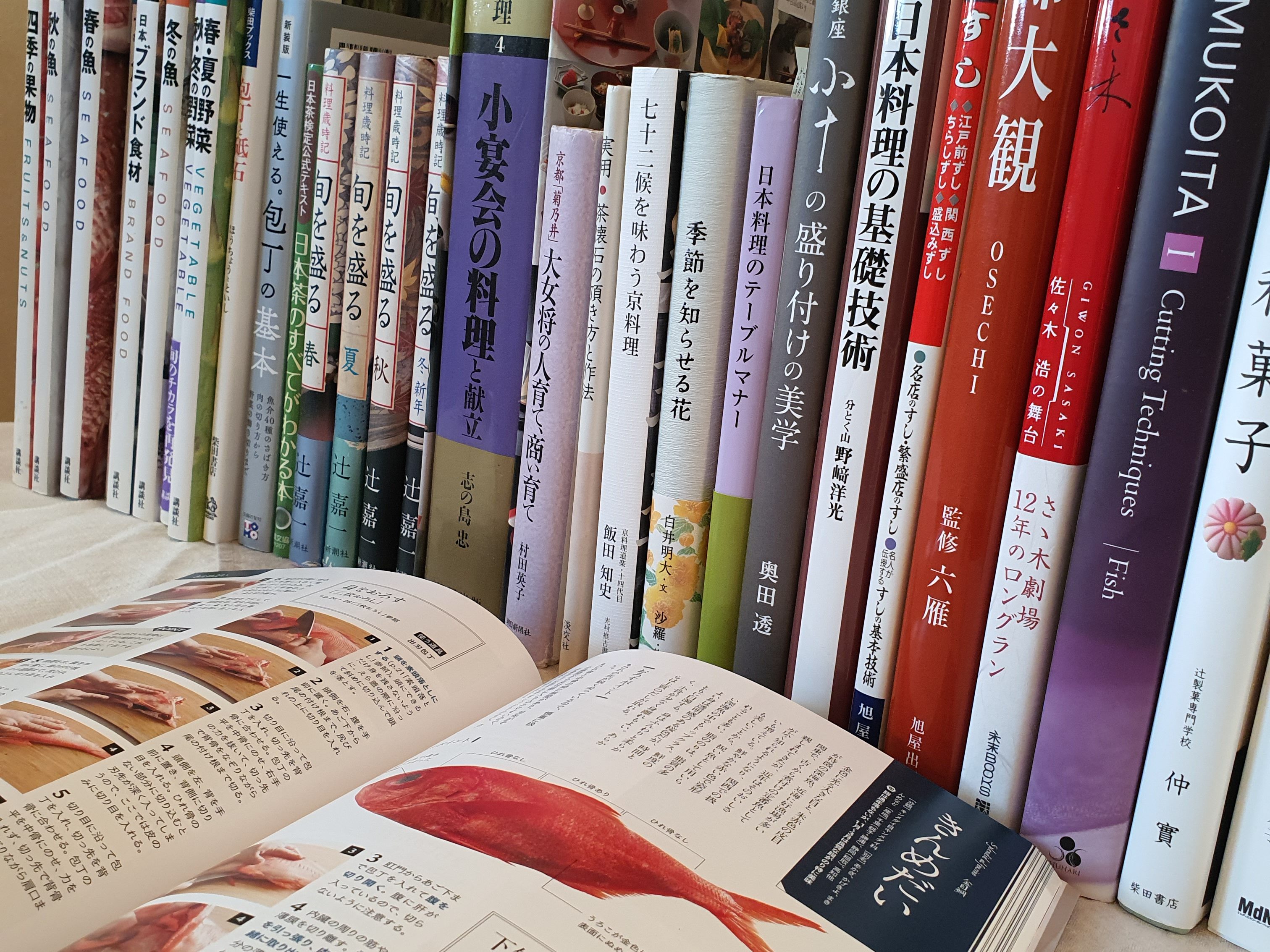
Small peek into my book collection

 Kaiseki at Home